
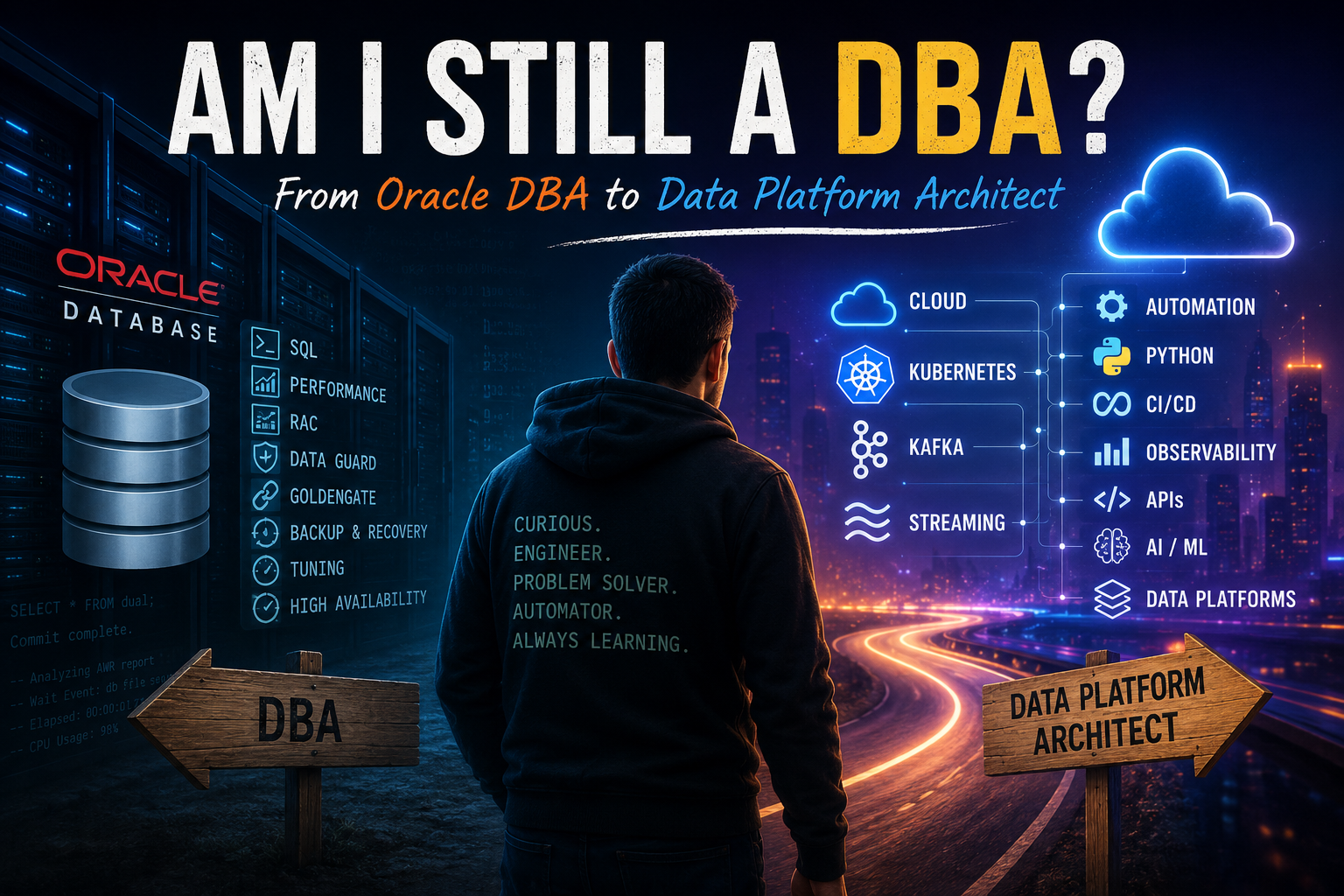
For many years, my job titles included words like “DBA”, “Senior DBA”, or “Database Architect”.
And honestly, I’ve always been proud of that.
Databases have been the foundation of my entire career. After nearly 15 years working with Oracle technologies such as Exadata, Data Guard, GoldenGate, RAC, performance tuning, high availability, and large-scale mission-critical environments, I can confidently say that databases shaped the way I think as an engineer.
But at some point, I started asking myself a simple question:
Am I still just a DBA?
The interesting part is that I never truly felt like a “traditional DBA”.
Even during my early years working exclusively with databases, I was always curious about what existed around them.
I wanted to understand infrastructure.
I wanted to automate everything.
I wanted to learn cloud.
I wanted to code.
I wanted to understand networking.
I wanted to understand how distributed systems worked.
I wanted to break things in labs at 2 AM and somehow enjoy it, yeah, i still do that sometimes…😂
Over the years, that curiosity slowly pushed me far beyond database administration alone.
Without even realizing it, I started spending more and more time working with technologies outside the traditional DBA world.
I became deeply involved in automation using Python and Shell scripting.
I started designing cloud and hybrid architectures.
I worked with Kubernetes, Docker, Kafka, S3, APIs, CI/CD pipelines, observability platforms, reverse proxies, certificates, and real-time streaming systems and many more!
At some point, I realized I was debugging Kubernetes networking issues and Kafka configurations as often as I was tuning SQL statements or analyzing AWR reports.
And honestly? I loved it.
Not because I stopped loving databases. Quite the opposite.
What I discovered is that having a strong database background became one of my biggest advantages when working with modern platforms and distributed systems.
When you spend years troubleshooting RAC clusters, Data Guard failovers, production outages, replication issues, storage bottlenecks, and strange? network problems that magically disappear the moment another engineer joins the call, you develop a very specific engineering mindset.
You learn to think about reliability.
You learn to think about scale.
You learn to think about performance.
You learn to think under pressure.
You learn how systems behave when things go wrong.
And that mindset translates extremely well into modern platform engineering.
Today, modern data platforms are no longer just databases. They include:
- cloud infrastructure
- automation
- containers
- streaming
- observability
- distributed systems
- AI
- platform engineering
- reliability
- security
- and continuous scalability
- …..
That evolution also changed the way I see my own role.
One thing that has always defined me throughout my career is curiosity and adaptability.
If someone asks me about a technology I’ve never worked with before, my answer is usually not:
“I don’t know.”
It’s more like: “Give me 5 minutes.”
Because I know I’ll learn it, understand it, build a lab for it, break it, fix it, and probably automate it shortly after.
That mindset has probably been one of the biggest drivers of my professional growth over the years.
And eventually, I realized something important:
The title “DBA” no longer fully represented what I actually do.
Not because databases stopped mattering to me. Not because I’m trying to move away from Oracle. And definitely not because I think the DBA role is less important today, because believe… it’s not!
In fact, I believe strong database knowledge is still incredibly valuable in a world obsessed with abstraction and automation.
But my day-to-day work evolved into something broader.
Today, my work is much closer to building and designing scalable data platforms than traditional database administration or architecture alone.
That’s why I recently decided to update my professional title to:
“Data Platform Architect”
Not because I’m leaving databases behind, but because modern engineering roles continue evolving, and honestly, I evolved with them.
Technology changes constantly, titles change constantly.
Curiosity, adaptability, and the willingness to keep learning are probably the only things that truly stay relevant over time.
Anyway, this is just a personal blog post… and something I have been thinking about it, if you have read this, thank you! and see you in the next one (still in draft)!
Leave a Reply